

When it comes to our eye health, we usually consider blurry vision a common problem. But what if other symptoms, such as glare around lights or seeing wavy lines more often, also appear? Finding out the exact eye disease or disorder becomes a daunting task. This is the major reason why conditions such as keratoconus and astigmatism are difficult to evaluate, resulting in selecting the wrong eye care plan. Due to the overlapping symptoms of both conditions, people often misinterpret the real cause behind their blurry and poor night vision. If you are also among those, then it is a must for you to understand the factors contributing to keratoconus vs. astigmatism, eventually making it crystal clear for you to seek the right treatment plan.
Due to the distinct characteristics of both conditions, their diagnostic and treatment options differ as well. The common treatment options such as LASIK or laser vision correction cannot be implemented if you have keratoconus due to its progressive nature. This is the reason why understanding keratoconus vs. astigmatism LASIK is crucial to get your hands on the right eye care plan.
Welcome to this blog post where you’ll be introduced to a guide to keratoconus and astigmatism, the difference between them and how the diagnostic and treatment options differ as well.
First, understand what keratoconus means!
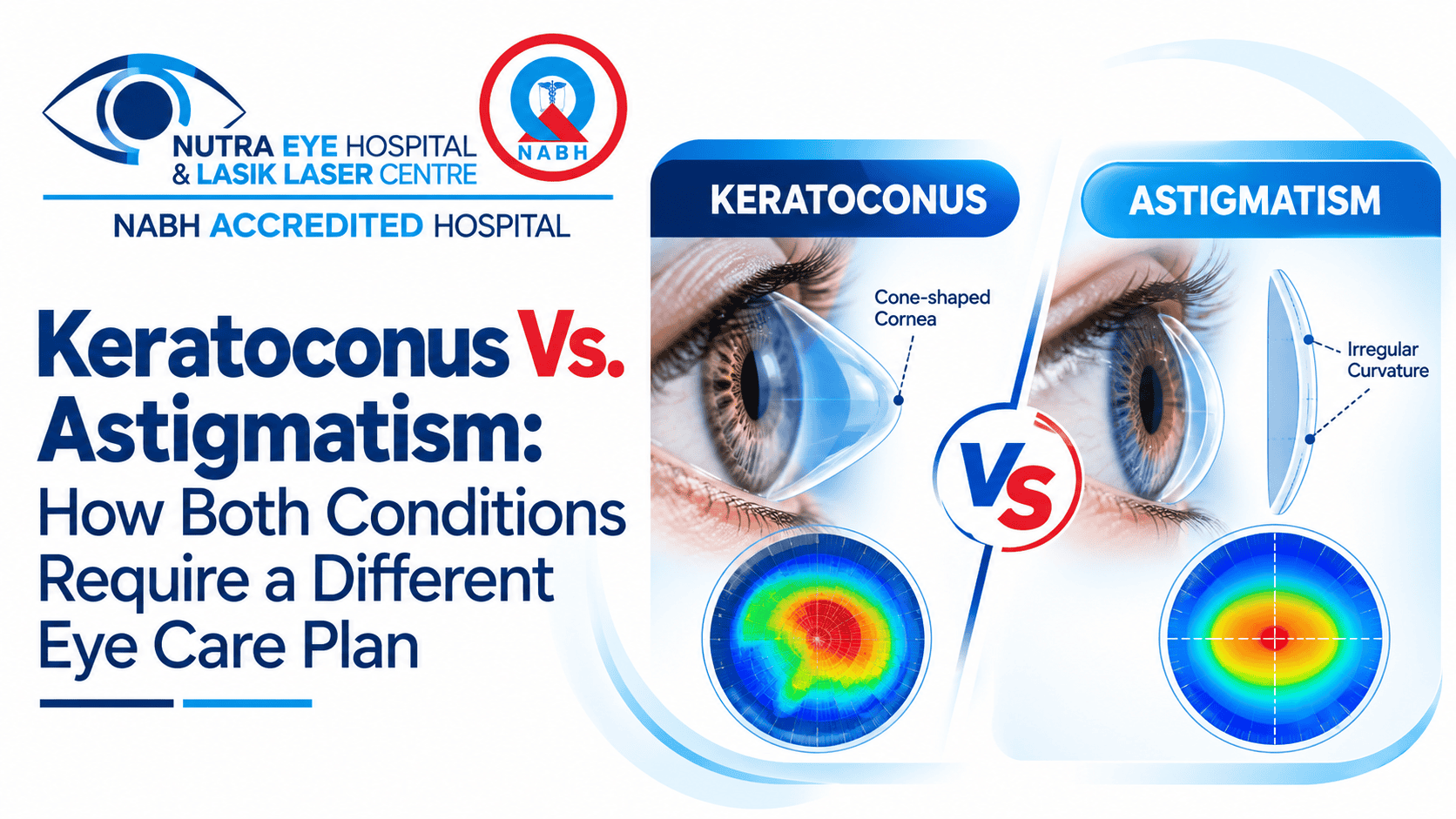
The process of thinning and bulging out of the cornea into a cone shape is associated with keratoconus. Due to such deformation, the way light reflects in front of your eyes differs as well, resulting in the formation of different symptoms.
Have a glance at its associated symptoms:-
- Blurry and distorted vision; often, straight lines appear wavy.
- Increased light sensitivity, struggling with halos and starbursts.
- Persistent change in eye prescription.
- Struggling with double vision along with ghosting images.
Now, understand what astigmatism means!
This includes the irregular shape of an eye or cornea, which turns into a football or oval shape instead of a round one is associated with astigmatism. Then, light becomes difficult to focus exactly on the retina due to the distorted corneal shape. Usually, astigmatism is present from birth; however, with age, it can be managed with different treatment options.
Here are its symptoms:-
- Experiencing headaches along with eye strain.
- Experiencing glare and halos around traffic lights, and poor night visibility.
- Blurry double vision at both near and far distances.
What are the shared symptoms between keratoconus and astigmatism?
Most individuals get confused between the symptoms of keratoconus and astigmatism, as both conditions involve the deformation of the cornea, apparently making it difficult for light to focus directly on the retina.
- Both conditions include blurry and distorted vision due to improper light reflection on the retina.
- Due to pressure on the eye muscles, struggling with eye strain is quite common in both conditions.
- Poor night vision and experiencing halos around lights are also common in both conditions.
- Double vision and frequent prescription changes are also common in both conditions, making it quite difficult to distinguish between the two.
Now that you have understood keratoconus and astigmatism, read the following points to understand their differences.
Different causes
Astigmatism: This is mainly caused by an irregularly shaped cornea or an eye lens, resulting in blurry vision.
Keratoconus: The deformation of the cornea and its altered shape are the major reasons for this condition.
Different progressive nature
Astigmatism: This condition remains stable in later life when the right eye care plan is followed.
Keratoconus: Without any advanced eye care plan, this condition gets worse.
Different onset timing
Astigmatism: This condition often starts in childhood and shows different noticeable signs.
Keratoconus: During teenage and adolescent years, this condition starts developing.
Different diagnostic approaches
Astigmatism: Through a normal eye test, along with refraction tests, this condition is thoroughly diagnosed.
Keratoconus: This involves quite advanced approaches such as corneal topography for an easy evaluation.
Different treatment options
Astigmatism: This can be managed with refractive surgeries such as LASIK, prescription eyeglasses and contact lenses.
Keratoconus: Advanced treatment procedures are opted for during this condition, including corneal transplantation and intrastromal corneal ring segments.
The Bottom Line!
Summing up the above-mentioned points, you might have understood the key difference between keratoconus and astigmatism and how their symptoms vary from each other. Certainly, despite sharing some common symptoms, both conditions differ due to their progressive nature or causes. If you have been experiencing any symptoms associated with the condition, then it is crucial to get in touch with your eye care specialist.
Mitra Eye Hospital and LASIK Laser Hospital ensure the use of advanced technology when it comes to providing you with eye care. Dr. H. Mitra is highly qualified and experienced in handling different eye conditions affecting your vision and day-to-day routine.
FAQs
- Do standard eye exams diagnose keratoconus?
A standard eye exam is not enough for diagnosing keratoconus, as it does not include the analysis of the cornea shape.
- How to self-diagnose keratoconus?
You can self-diagnose keratoconus by thoroughly assessing yourself for its warning signs, including double vision, progressively blurry vision, and halos and glare more often.
- Can a child with astigmatism be managed?
Yes, astigmatism in children can be managed by adapting different treatment options, including contact lenses and eyeglasses, after precise monitoring sessions.
- What are the worsening symptoms of keratoconus?
The worsening symptoms of keratoconus are associated with increased blurriness, along with severe glare and intolerance towards the use of contact lenses.
- Can small children also have keratoconus?
Yes, small children can have keratoconus; however, it is quite rare, and teenagers and adolescents are most likely to be affected.